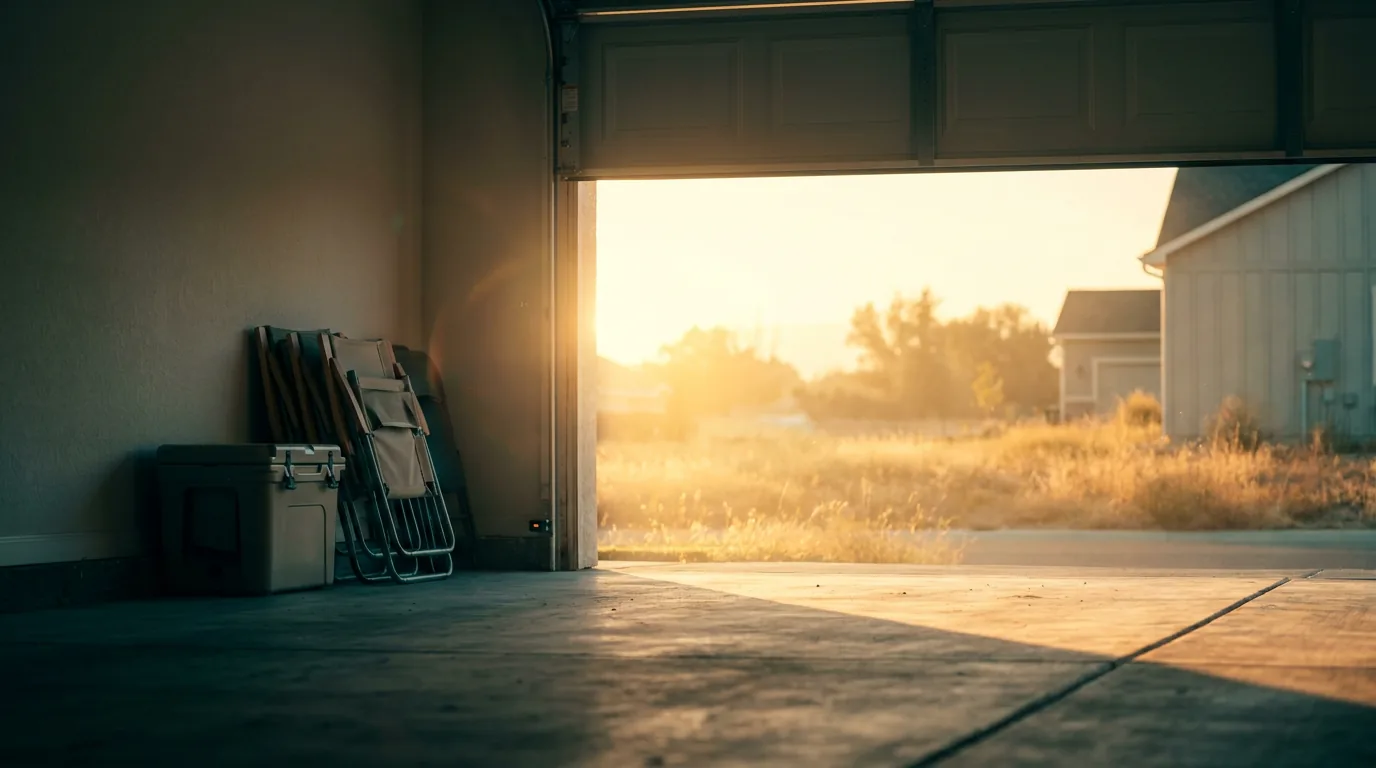
By two in the afternoon on Thursday the front door has been forgotten. Everyone comes and goes through the garage: the cousins carrying folding chairs, someone fetching ice from the chest freezer, the kids running back and forth because the door makes a noise when it moves and that is more interesting than the parade. A door that runs four times on a normal day will run thirty.
None of that is a reason to worry about the door. It is a reason to spend fifteen minutes with it today, because a full house finds the faults that were already there, and the worst time to discover the door will not close is when everyone is leaving in the dark.
A busy day does not wear out a door. It finds what is already worn.
Springs and rollers count cycles, and thirty in a day is nothing to a door that will run tens of thousands in its life. What a busy day changes is the odds. A spring a few cycles from the end, a roller already binding, a photo eye that only just sees its partner: each was going to fail on some ordinary Tuesday, and more cycles in one day bring that Tuesday forward. The useful checks are the ones that find those parts before the guests do.
Keep the bottom six inches of the opening clear
The garage fills up for the holiday. Coolers, cases of drinks, a stack of chairs, the extra trash bags. They end up wherever there is space, which is often along the inside wall right next to the door, and the photo eyes are bolted to the tracks no more than six inches off the floor. A cooler pushed against a sensor bracket at noon is a door that will not close at nine, when the last car leaves.
Keep a strip of floor clear along both tracks, and check that the small lights on both sensors are steady once everything has been stacked.
Know which breaker the opener is on
An extra refrigerator or freezer, a slow cooker or two on the workbench and a space heater for the people who end up out there can all land on the garage circuit. If it trips, the opener goes dark along with everything else. Find the breaker before Thursday, so nobody is searching the panel with a phone light while the door sits open.
If the opener has a battery backup, which openers sold in California have been required to have since 2019, it will keep running for a while on battery.
If it does not and the power stays off, the release cord lets you move the door by hand, but only on a door whose springs are whole. On a door with a broken spring, pulling the cord while the door is open lets its full weight down at once.
The fryer stays outside
This is not a garage door problem, but it is a garage problem, and it would be odd to write about this week without it. A turkey fryer belongs outdoors on level ground, well away from the house, and fire safety guidance names the garage specifically as somewhere it should not be. An open door does not change that. Hot oil, a gas burner and a room full of cars and cardboard do not belong together.
The keypad and the spare remotes
A full house usually means someone needs a way in without a key. Many keypads can hold a second code alongside yours, and some can be set so that code expires after a number of hours or uses. That is a better arrangement than handing out your own code, which tends to outlive the visit.
Before anyone arrives:
- Set up a second keypad code if yours allows it, and make a note to delete it afterward.
- Count the remotes, so you know how many should be back in the house on Sunday.
- Change the keypad battery, which has probably never been changed.
- Show whoever gets the code how the keypad closes the door as well as opening it, so it does not stay open overnight.
The checks for today
- Run the door through a full cycle and listen. A new grind, squeal or bang is worth knowing about now, not on Thursday afternoon.
- Look at the springs from the floor. A gap in a coil means the door should not be used, holiday or not.
- Test the auto-reverse by closing the door on a piece of wood laid flat in the opening. It should reverse as soon as it touches.
- Check that the wall button is high enough, at least five feet up, where small hands cannot reach it.
- Switch on the opener light and check the bulb. It is dark before five now, and the guests will be leaving after that.
- Walk the opening after the garage is stacked and make sure the sensors can still see each other.
And tell the children the door is not a game. Opener manuals put it plainly: nobody runs under a moving door, and nobody rides it.
If something breaks on the day
If a spring goes on Thursday morning with the cars inside, the honest advice is that nothing about Thanksgiving requires those cars. Leave the door closed, unplug the opener, disconnect the backup battery if it has one, and let the guests park on the street. A broken spring is a calm repair on Friday and a dangerous one if a relative with a ladder decides to help.
If the door will not close at the end of the night and the springs are fine, it is almost always the sensors. Move whatever is stacked next to them, wipe the lenses and try again before anyone starts holding the wall button down to force it.
The verdict: a good door goes unnoticed
A door that is in good shape will run all day and never be noticed, which is how it should be. Fifteen minutes today, mostly spent moving coolers away from the sensors and finding a breaker, takes care of most of what could go wrong. The rest is a spring that was going to break anyway, and if that is the one thing that goes wrong this week, it is still one of the most ordinary repairs there is.
Garage Door Doctor’Z · (833) 991-3899 · doctorzgaragedoor.com
CSLB C61/D28 · Lic. 1138150 · Serving the Sacramento Valley since 2024.