
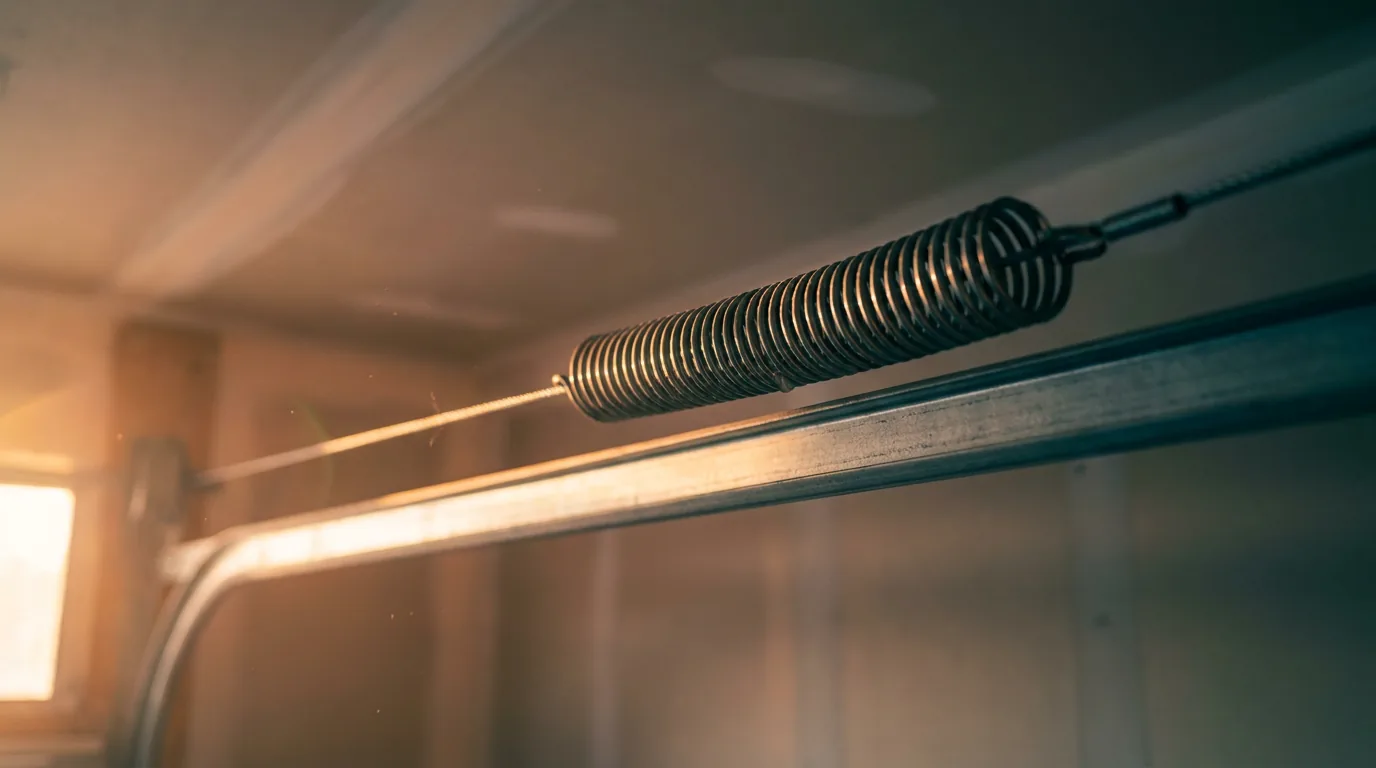
Open the garage door, look up, and on each side, running alongside the horizontal tracks that hold the door when it is open, there is a long spring. Right now they are at their shortest and nearly slack. Close the door and they stretch out to well over their resting length, humming faintly, like a pair of rubber bands the size of a forearm.
Those are extension springs. Plenty of doors have them, especially single doors and older installations, and they get far less attention than the torsion spring on a shaft above the door that most garage door advice is written about. They do the same job in a different way, and they fail in a different way.
How a spring that stretches lifts a door
When the door closes, each spring is stretched, and the stretching stores energy. A cable runs from each bottom corner of the door up over a pulley near the top of the opening, back to a pulley fixed to the end of the spring, and forward again to an anchor. As the door rises, the springs pull back toward their resting length and the cables lift the door with them. The pulley on the spring doubles the cable's travel, so a spring that shortens by a few feet can lift a door seven or eight feet tall.
That is also why the springs are sized to the door. They are made in standard lift ratings, usually marked with a color on the ends, and in lengths matched to the door's height. An 8-foot-tall door needs springs that can stretch further than a 7-foot one, and a spring chosen for the wrong height will either run out of stretch or never quite lift the door.
The cable that is supposed to run through the middle
This is the one thing worth checking today. A properly installed extension spring has a separate steel cable running straight through its center, anchored at the front and back of the track. It does nothing while the spring is whole. When a stretched spring breaks, the pieces want to fly apart with all the energy that was in them, and the safety cable is what keeps them on a leash instead of sending a length of steel across the garage into a windshield or a person.
Look up the middle of each spring. If you can see a cable through the coils, good. If you see open air, the door has no containment, and that is the most dangerous thing about it. Doors installed decades ago and springs replaced in a hurry are the usual places it goes missing.
How they fail
Like torsion springs, extension springs wear out by counting cycles, and eventually one breaks. Unlike torsion springs, the system around them has several other places to fail:
- The spring itself breaks, usually near one end, or the hook at the end opens out and lets go.
- A pulley seizes or cracks. A pulley that stops turning drags the cable across it, and the cable frays at that spot first.
- A cable frays or snaps, often at the bottom bracket, where it has spent years in the dirt and the damp.
- A bottom bracket loosens or rusts, and the cable starts pulling the corner of the door out of shape.
- The springs tire unevenly, one more than the other, and the door rises crooked.
A door that is lower on one side as it opens, or that squeals near the top of its travel, is often telling you about the pulleys or the cables rather than the springs.
Why they are replaced in pairs
The two springs share the door's weight, one on each side. If one breaks after so many years, the other has done the same number of cycles and is close behind. A new spring next to an old one also pulls harder than its partner, which tilts the door and wears the cables, rollers and pulleys unevenly. Replacing both at once costs a little more on the day and saves a second visit, and it is the same advice we give about torsion springs for the same reason.
Ask about the pulleys and cables on the same visit. On a door old enough to break a spring they have done the same years, and changing them while the springs are off is far less work than coming back for them.
Why this is not a weekend job
Extension springs are sold on the shelf at hardware stores, which makes replacing them look like a weekend job. It is not one: a closed door holds both springs fully stretched, and that stored tension is what hurts people when a spring, a hook or a cable lets go halfway through, so spring replacement is a job for a technician.
Should you convert to a torsion spring
It is sometimes offered as the obvious upgrade. Torsion springs keep their energy wound on a shaft above the door, which runs a little smoother, puts the stored force in one place instead of along both tracks, and leaves fewer parts moving overhead. On a heavy double door it can be the better system.
But a conversion is a choice, not a repair. A working extension spring system with matched springs, sound pulleys and a safety cable in each spring is not a defect, and nobody should be told it has to go because one spring broke.
If one is suggested, it is fair to ask what is wrong with the system you have. If the only answer is that torsion is better, that is a preference, not a fault.
The verdict: look for the cable first
Check for the safety cables. If they are there and the door rises level, extension springs are a perfectly ordinary way to lift a door, and when one breaks the repair is two springs and a look at the pulleys. If the cables are missing, have them added, whoever does the work. That is the one part of this system we would argue for, and it is one of the smallest parts on the door.
Garage Door Doctor’Z · (833) 991-3899 · doctorzgaragedoor.com
CSLB C61/D28 · Lic. 1138150 · Serving the Sacramento Valley since 2018.