
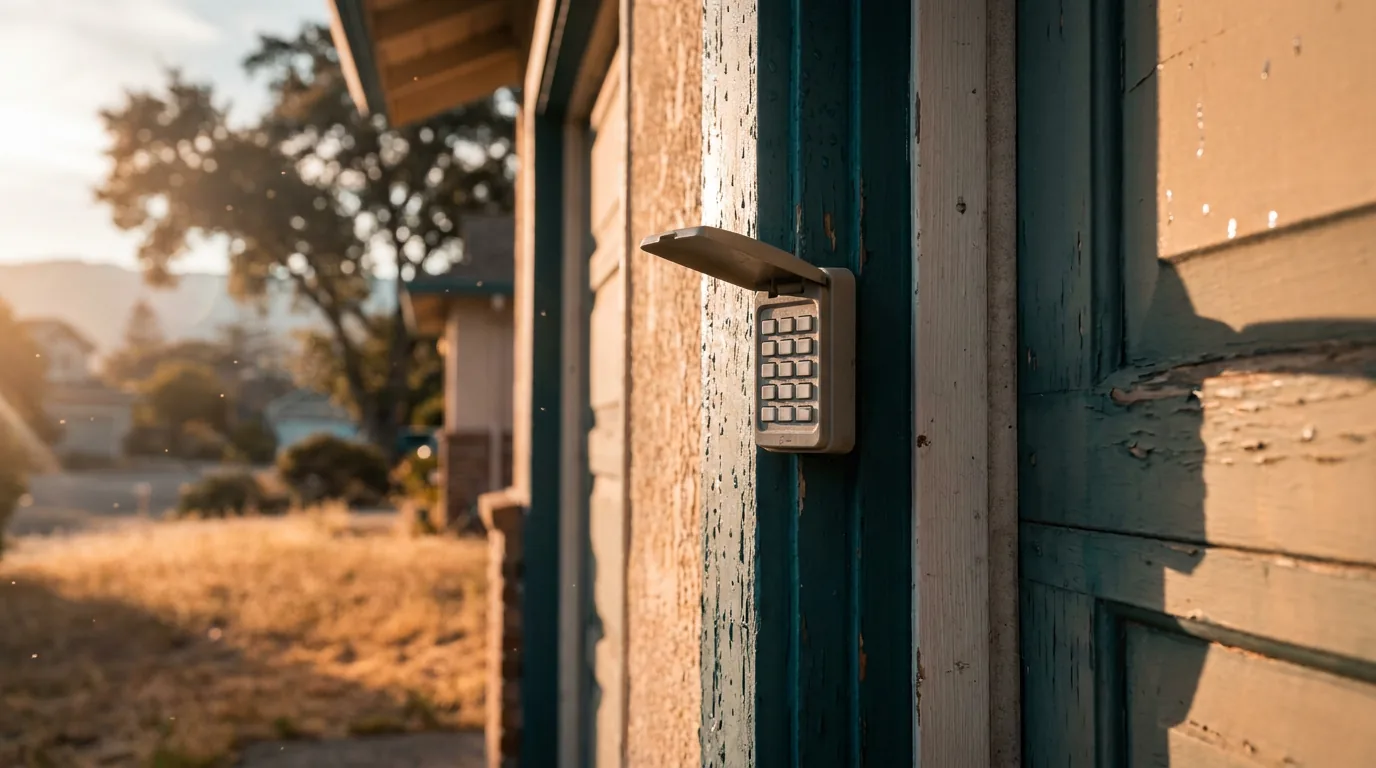
It is raining, the house key is on the kitchen counter, and the keypad beside the garage door takes the code, lights up, and does nothing. Try it again, slower. Nothing. The phone has the garage door company's number in it, but the opener is on the other side of the door that will not open.
A wireless keypad feels like part of the door. It is not. It is a remote control screwed to the wall outside, and nearly every way it fails is a way a remote fails, plus a few that come from living outdoors. The quickest route to the answer is to stop working on the keypad and find out what else in the system still works.
A keypad is a remote that lives outside
Most garage keypads are not wired to anything. Inside the case is a battery, a small radio transmitter and a memory holding your code. When you enter the code, the keypad sends the same kind of signal a visor remote sends, and the receiver inside the opener's motor head decides whether to accept it. The keypad never touches the door, the motor or the wiring.
So a keypad fault can sit in three places: the keypad itself, the radio link between it and the opener, or the opener's receiver. Each one has a tell.
Sort it with the other buttons
Before opening anything, try every other way in that you have:
- The remotes work and the keypad does not. The problem is the keypad. Battery, pairing, or water.
- The wall button inside works, but nothing wireless does. Remotes and keypad have all been shut out at once. That is the lock function on the wall control, or the opener's receiver.
- Nothing works, including the wall button. It is not the keypad at all. It is power to the opener, or the opener.
- The keypad works some days and not others. A weak battery or water in the case, both covered below.
- Everything works, but only up close. That is range, which usually points at the receiver's antenna or something in the motor head interfering with it.
That sorting takes a minute and decides whether the next step is a battery or a technician.
The battery, every time, first
Keypad batteries last so long that nobody remembers there is one. Depending on the model it is a 9-volt or a pair of small cells, behind the cover or in the back of the case. A keypad on a weak battery often still lights up when a key is pressed, which is what convinces people the battery is fine. Lighting a few LEDs takes much less than sending a signal across a garage.
Replace it with a new one rather than one from the drawer, and look at the contacts while the cover is off. A green crust on them means water has been inside.
A summer of sun, then a winter of rain
A keypad on a west-facing jamb in the Valley spends four months in the afternoon sun. The plastic cover fades and goes brittle, the rubber keys harden, and the seal around the case shrinks. Then the first storms of November drive rain into the gaps, and a keypad that survived the heat quietly floods. Corroded contacts and a damp circuit board can make a keypad work on dry afternoons and fail on wet mornings, which looks like a mystery and is mostly weather.
A keypad that has had water in it can sometimes be dried out and cleaned. One with a cracked case will flood again with the next storm, and is worth replacing.
When the keypad has forgotten the opener
A keypad has to be paired to the opener, the same way a remote is, through the learn button on the motor head. Anything that clears the opener's memory, such as a new logic board, a replacement opener, or a new owner deliberately wiping it after moving in, also unpairs the keypad. The keypad still takes your code and lights up. The opener simply no longer recognizes the signal.
There is a second version of this. Opener makers have changed their radio coding over the years, and a keypad from an older generation may not speak a newer opener's language at all. If your opener was replaced recently and the keypad stayed, that is the first thing to check, and the manual for the new opener lists which keypads it accepts.
On many openers, pairing a keypad runs roughly like this, though the manual for your model has the final word:
- Find the learn button on the motor head, usually under the light cover or on the back.
- Press it once and let go. A small light beside it comes on.
- Within about half a minute, enter the code you want on the keypad and press its enter key.
- Watch for the opener light to blink or listen for a click. That confirms it.
- If it does not take, check the keypad battery first. A keypad on a weak battery can fail to pair just as it fails to open the door.
The keypad is also telling the street your code
On a keypad that has been in use for years, the four keys of the code are the worn ones: shinier, faded, or with the numbers half gone. Anyone standing at the door can narrow the code down to the order of four digits, which is not many guesses. Changing the code to one that uses different keys costs nothing, and it is worth doing whenever the battery is changed, or replacing the keypad if the keys have worn smooth.
The verdict: usually the battery, then the pairing
Most dead keypads are a dead battery or a keypad that lost its pairing when something changed at the opener. Both are fixed at the door with the manual and a few minutes. A keypad that has flooded or cracked is a small part, and replacing one is not a repair worth a service call on its own.
If the remotes and the wall button have stopped as well, the keypad was never the problem, and that is when it is worth calling. It is a slightly odd thing for a garage door company to tell people to fix themselves, but most keypads need a battery, not us.
Garage Door Doctor’Z · (833) 991-3899 · doctorzgaragedoor.com
CSLB C61/D28 · Lic. 1138150 · Serving the Sacramento Valley since 2018.