

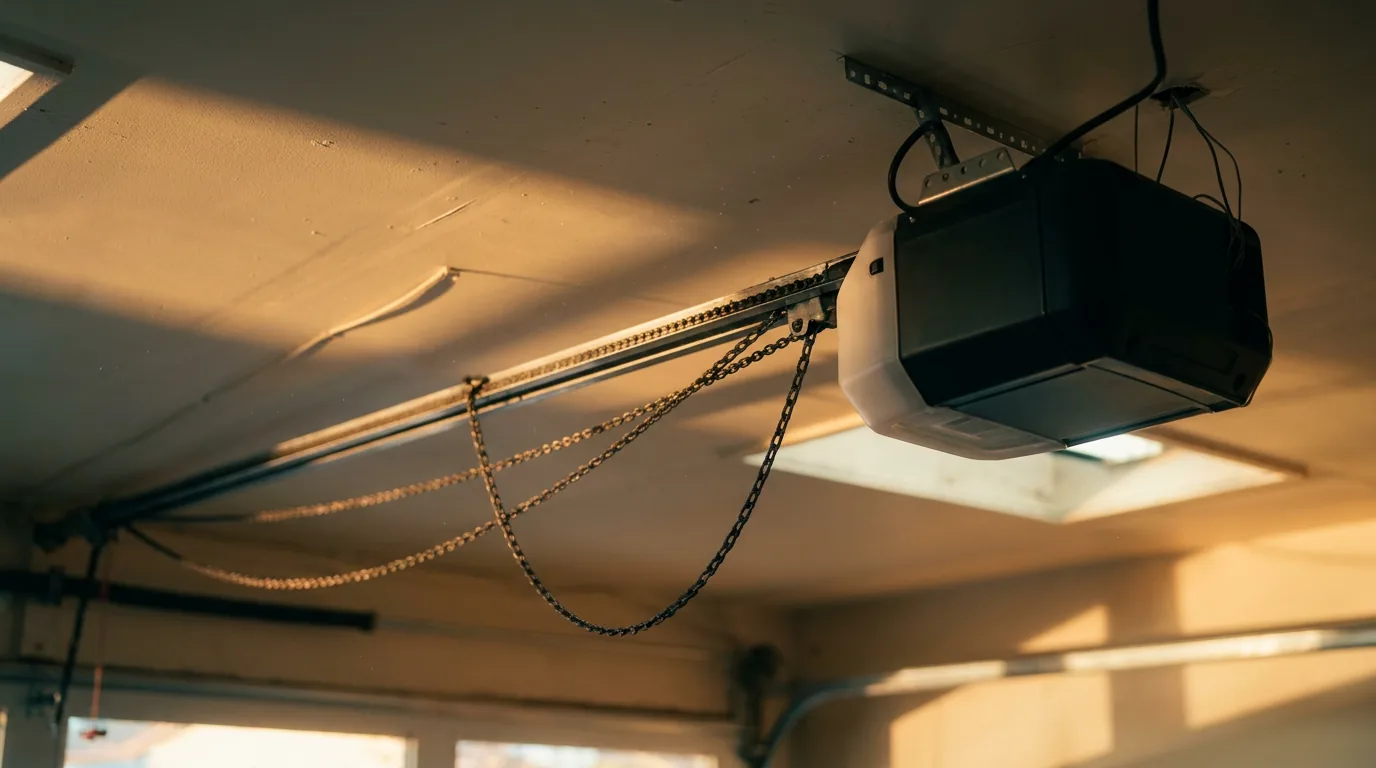
The opener starts, the motor runs, and instead of the usual steady grind there is a rattle, a slap and then a length of chain hanging in a loop below the rail like a dropped necklace. Sometimes the door got halfway first, and the chain is now draped across the roof of the car.
A chain that has come off its sprocket looks like the whole opener has failed, and it usually has not. Putting it back takes a few minutes for someone who has done it before. The useful question is the one nobody asks once it is back on: what knocked it off in the first place.
How the chain moves the door, and why it can come off
On a chain-drive opener, the motor turns a small toothed sprocket at the head unit. A chain runs from that sprocket the length of the rail, around an idler at the far end above the door, and back, with both ends fixed to the trolley, the carriage that slides along the rail and connects to the door through a short arm.
The main thing keeping the chain on the sprocket is tension, helped on many models by a cover or guide around the sprocket. Set correctly, it sits snug against the teeth and runs without slapping. Slack, it can ride up and over a tooth the moment the load changes suddenly, and once one link is off the rest follow. So a chain that came off is, almost by definition, a chain that was loose at the moment something jolted it.
The jolts that throw a chain
Chains do stretch slightly over the years and need taking up now and then. But a chain rarely comes off from slack alone. Something usually gave it a sharp tug:
- The door stopped hard. A roller jammed in the track, a door that came off track, or something under the door that the force setting missed. The motor kept pulling.
- The door is heavier than it should be. Weak or broken springs leave the opener lifting most of the door. Every start is a jerk on the chain, and the chain is the first part to let go.
- The rail has moved. A loose bracket on the wall above the door, or a ceiling hanger that has worked loose, lets the rail flex and changes the chain's path.
- The sprocket is worn. Teeth rounded off after years of service, or a cracked sprocket, give the chain less to grip.
- The door was hit. A bumper or a bike handlebar meeting a moving door jerks everything attached to it, chain included.
What to do before anyone touches it
Leave the door where it is. If it is stuck open, keep cars and people out from under it, because a door that threw its chain over a broken spring has nothing holding it up at all, because with the chain off the sprocket the opener is no longer connected to it. Then unplug the opener, and disconnect its backup battery if it has one, because an opener with a battery will still answer a remote or a keypad while it is unplugged.
Then look up at the springs above the door. If there is a gap in a coil, the chain is the second problem, not the first, and putting it back on will only give the opener another chance to strain against a door it cannot lift.
Putting it back on, and the honest part
On most chain-drive units this is not a difficult job. The trolley is released, the chain is fed back around the sprocket, which on many models sits under a small cover on top of the motor head, the tension is set at the trolley with the adjusting nut, and the door is reconnected. The manual gives a target tension, and it matters, because too tight is its own fault: it loads the sprocket and the motor's bearings on every run.
We would rather you knew that than called us for it. A handy person with the manual, the door closed and the power off can usually manage it. What a handy person cannot tell from a ladder is whether the door that threw the chain is still the door the opener was set up for.
Why a chain that comes off once tends to come off again
Put a chain back on a heavy door and it will stay on for a while. Then it stretches a little, the springs lose a little more, and on some cold November morning when everything is a little stiffer, the trolley gets one jerk too many. The second time it happens, people tend to blame the opener and start shopping for a new one.
That is the expensive mistake. An opener rarely throws its chain just because it is old. It throws its chain because something between the motor and the floor is resisting it, and a new opener bolted to the same door meets the same resistance.
Five minutes of checks after the chain is back
Once it is running again, these tell you whether it will stay on:
- Pull the release cord with the door closed and lift it by hand. It should rise with modest effort and stay put around halfway. If it is heavy or drops, it is the springs.
- Watch the chain through a full cycle. A little droop along a long rail is normal. A chain that slaps the rail or rattles at the start of each run is still loose.
- Look at the bracket above the door while the opener starts. It should not move. If the rail bucks or the bracket flexes, it needs fixing to something solid.
- Listen at the head unit. A clicking or skipping sound as the door starts can be the chain jumping worn sprocket teeth, or a worn drive gear inside the motor head. Either way it is the head unit, not the chain's tension.
- Prove the reversal. Close the door on a piece of wood laid flat on the floor. It should reverse as soon as it touches.
What about belt drives
Belt-drive openers use a reinforced rubber belt in place of the chain and throw it far less often. When one does slip or come off, the causes are the same: a door that stopped hard, a heavy door, a loose rail.
The verdict: the chain is the messenger
A chain off its sprocket is one of the smaller things that can happen to an opener, and on a balanced door it is a few minutes' work with no new parts. If the door lifts lightly by hand and the rail is solid, put it back, set it to the manual's tension and forget about it.
If the door is heavy, the chain was not the fault, and the repair that actually keeps it on is the springs. That is a less satisfying answer than a quick fix up at the opener, and a more useful one. We would rather sell you a spring than a second visit for the same chain.
Garage Door Doctor’Z · (833) 991-3899 · doctorzgaragedoor.com
CSLB C61/D28 · Lic. 1138150 · Serving the Sacramento Valley since 2018.