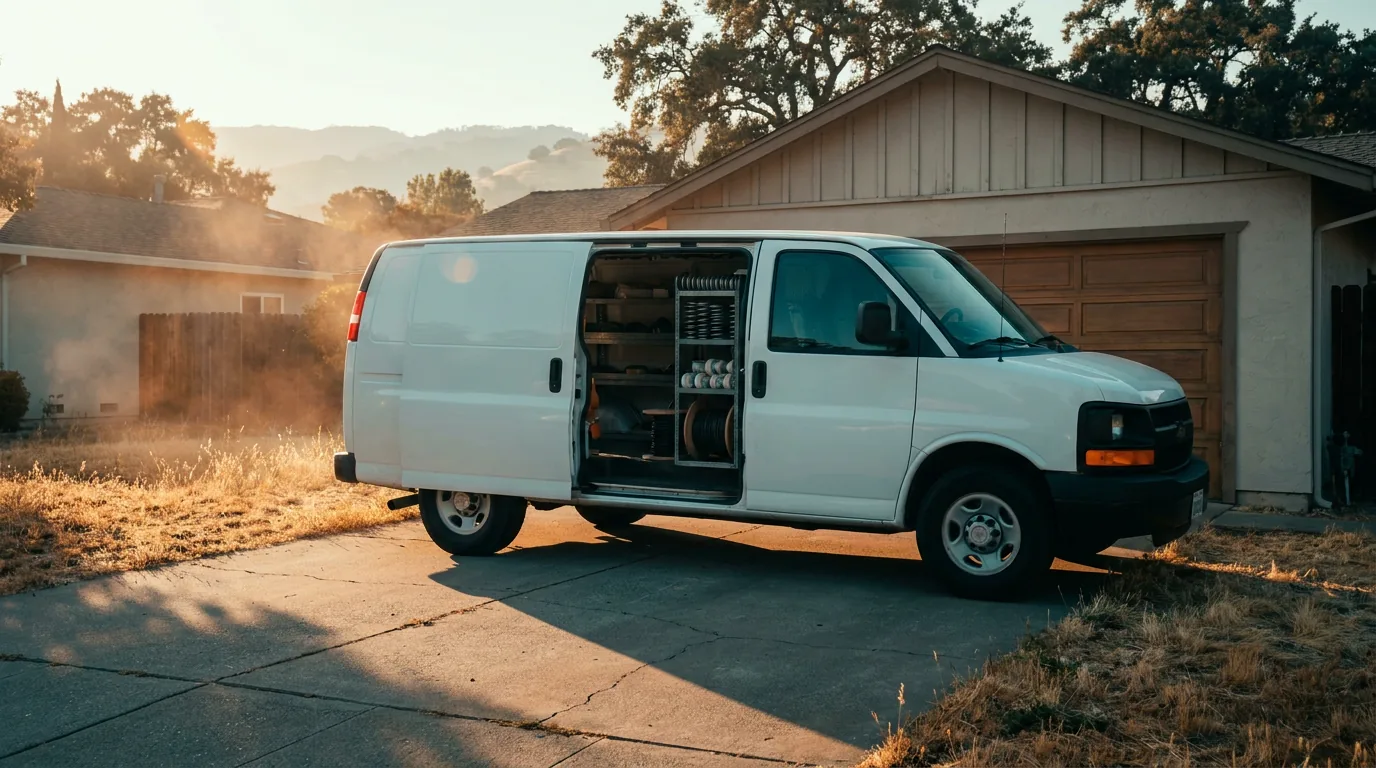
The door is stuck, the car is inside, and the first three companies on the phone all say "same day." All three may mean it. What all three mean is that someone will arrive today. Whether the door works by tonight depends on something none of them can know yet: whether the part it needs is on the van.
Same-day is a promise about arrival. The repair depends on what broke, and some garage door parts are carried on every van in the trade while others have to be ordered from the company that built the door. Knowing which is which saves a lot of frustration, and it helps you judge what you are being told on the phone.
Why some parts travel and some do not
A garage door is mostly standard hardware wrapped around a few parts that are not. Springs, rollers, cables, drums, hinges and bearings come in a limited range of sizes that fit most residential doors, whoever made them. A technician can carry the common ones, and usually does. The sections of the door itself, the panels, are the opposite: they are specific to the maker, the model, the design, the height and the color, and nobody can carry them all. Springs show the difference: most residential doors fall within a fairly narrow band of weights and heights, which is why a well-stocked van covers most spring jobs.
So the rule of thumb is simple. If the broken part moves the door, it is probably on the van. If the broken part is the door, it probably is not.
Openers sit somewhere in between. A van can carry the parts that fail most often on popular units, such as drive gears and sensors, and sometimes a few common replacement openers, but not every circuit board for every model ever made.
Usually done in one visit
- Broken torsion or extension springs in common sizes, which covers most residential doors.
- Snapped or frayed cables, and the drums they wind onto.
- Worn or broken rollers and hinges.
- A door off its track, as long as the track and sections are not badly bent.
- Photo eyes, bottom seals and many opener parts, such as drive gears and remotes.
Usually ordered
- A dented or cracked section. It has to match the rest of the door, and on an older door the design may no longer be made.
- A whole new door, which is usually built to order in the size, insulation and finish chosen, unless a stock door in a standard size happens to suit.
- Unusual springs, including a few proprietary systems that only take the maker's own parts, and springs for very heavy or very tall doors.
- Particular opener circuit boards, and replacement openers in one specific model.
What happens when the part has to be ordered
A door that needs an ordered part does not usually have to stay broken in the meantime. A cracked section can often be braced so the door runs carefully until the new one arrives, or the door can be secured closed if it is not safe to run. A failed opener board can be worked around by disconnecting the opener and using the door by hand, provided the springs are sound. The visit that day is about making the door safe and usable; the repair comes when the part does.
Ask what the temporary arrangement is, and whether the door is safe to run with it, before the technician leaves.
That is worth knowing because it shapes what a reasonable visit looks like. A technician who arrives, finds a part has to be ordered, makes the door safe and explains the wait has done a good day's work, even though the door is not fixed yet.
How to make a one-visit repair more likely
The most useful thing you can do is send photographs before anyone sets off. Three pictures turn a guess into a parts list:
- The springs, from the floor, close enough to see the coils and any gap.
- The label on the inside of the door, often on an end stile or the top section, which identifies the maker and model.
- The whole door from inside, closed, showing the tracks and the opener.
With those, a company can tell you whether the spring size is one it carries and whether the damage involves a section, before the van leaves.
The questions on the phone are the parts list
Expect a few questions on the phone that sound fussy: how wide the door is, whether the springs are above the door or along the tracks, whether there is a label. A photo of the label answers half of them at once. Nobody is stalling. Those answers decide which springs and cables go on the van before it leaves.
If nobody asks anything and still promises the door working tonight, the promise is about the van, not the door.
The sentence to be wary of
"We can't get that panel, but we can put in a whole new door today." Occasionally that is true and the honest answer, on a door that is genuinely finished. Sometimes it is a door that needed one section and has been offered a full replacement because a new door is quicker to sell and earns more. If the only thing wrong is one panel, ask how long the panel takes and whether the door can be braced until then. A few weeks with a braced door is usually a better outcome than a new door you did not need. And if a new door does turn out to be the right answer, it is a decision worth more than an afternoon, whatever happens to be on the truck.
The verdict: one visit usually fixes what moves the door
Most of the repairs that stop a door working, the springs, cables and rollers, are usually fixed on the first visit, because the parts are standard and the trade carries them. Most of the repairs that make a door look wrong, the dents and cracked panels, are not, and anyone who promises otherwise on the phone is guessing.
We would rather tell you it will take a few weeks and be right than say today and be wrong. It may lose the occasional call to whoever said today, and it is still the answer that holds up.
Garage Door Doctor’Z · (833) 991-3899 · doctorzgaragedoor.com
CSLB C61/D28 · Lic. 1138150 · Serving the Sacramento Valley since 2024.