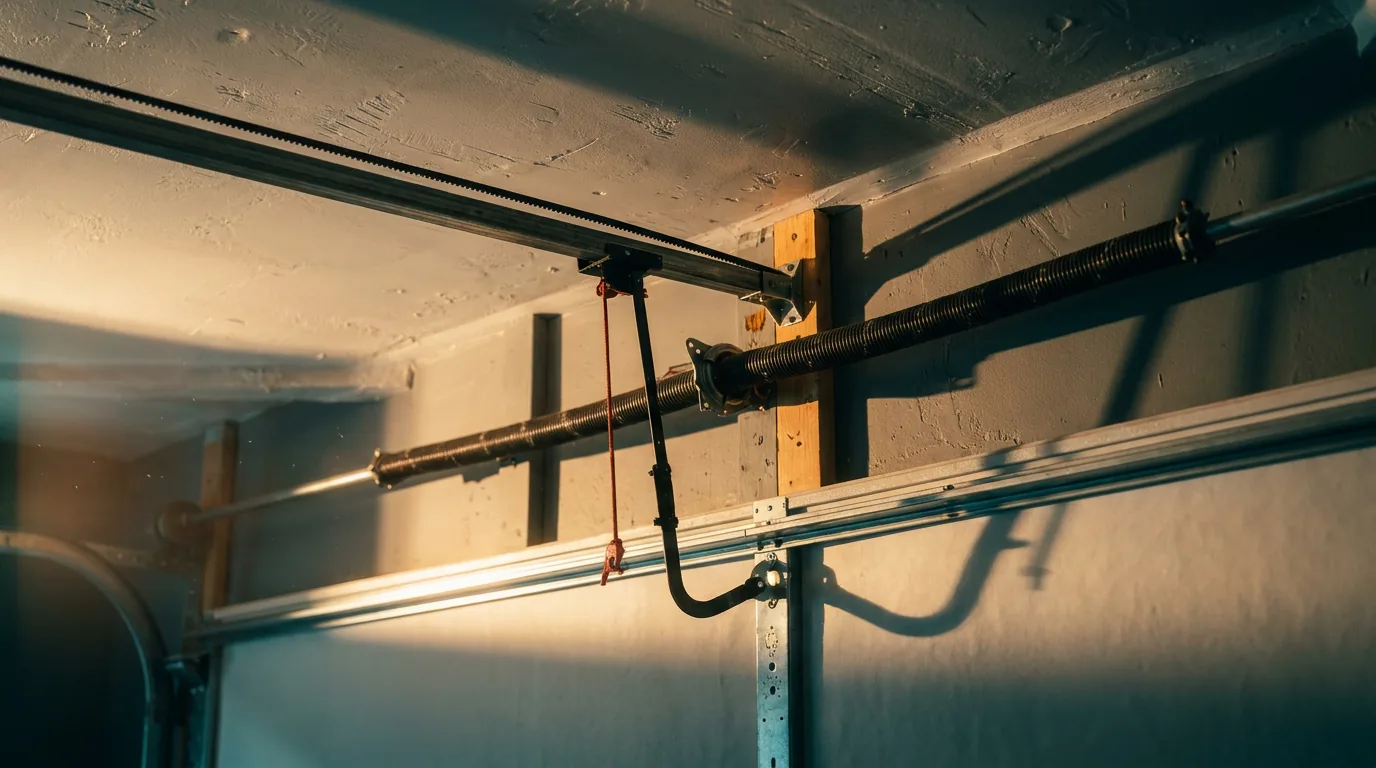
It starts as a faint crease across the top section, just beside where the opener arm is bolted to the door. A year later the crease has a twin, and when the door closes the top panel bows outward for a moment before the rest of the door catches up. Eventually somebody notices that the screws in the opener bracket have started pulling out of the steel.
A bent top section looks like a door problem, and the section is the part that ends up damaged. But a panel that bends where the opener pulls is almost always being pushed past what it was built for by something else, and replacing the panel without finding that something gets you a second bent panel.
The whole pull of the opener lands on a few square inches
An opener moves the door through a single arm, bolted to a bracket on the top section. Every time the door opens, the opener pulls the top of the door back and up through that one point, and every time it closes, it pushes the same point forward and down. On a well-balanced door that is not much force, because the springs are carrying the weight and the opener is mostly steering.
The top section of many steel doors, particularly uninsulated single-skin doors, is a thin sheet with ribs pressed into it. It is strong along its length and much weaker across it. Concentrate enough force in the middle of it, often enough, and it folds along a line, usually a rib or the edge of the bracket. Insulated doors, with steel on both faces and foam between, resist it far better, though not forever.
What pushes it past the limit
- Springs that no longer carry the door. As springs weaken, the opener does more of the lifting, and all of that extra effort goes through the bracket.
- A down limit set too low. If the opener keeps driving after the door reaches the concrete, it pushes the top section forward while the bottom has nowhere to go. That is the outward bow you see as it closes.
- Force turned up to get past a door that was sticking, which lets the opener push harder against everything, including its own bracket.
- No reinforcement. Many lightweight doors are meant to have a steel strut or a reinforcing bracket across the top section when an opener is installed. On plenty of doors it was never added.
- A door arm set at the wrong angle, pulling the panel inward more than upward.
Most bent top panels have two or three of these at once. Weak springs lead to more force, more force leads to a door pressed into the floor, and the bracket takes all of it.
Check it from the floor
Three things tell you which of those you have. Watch the top section as the door closes the last foot. If it bows outward after the bottom touches, the down limit is wrong.
Then, with the door closed, pull the red release cord and try the door by hand. Heavy, or unwilling to stay put at waist height, means the springs are behind it.
Finally, look across the inside of the top section for a horizontal steel bar or angle; if there is nothing there but the opener bracket, the panel has been taking the load alone.
Look at the bracket itself while you are there. Screws pulling out, torn steel around the bracket or a crack spreading from its corner are signs the section is near the end of what it can take.
A crease is not always a new panel
This is where the repair can go two ways, and the cheaper way is often right. A top section with a mild crease, no torn steel and a solid bracket can usually be stiffened with a strut across its width and a reinforced bracket, once the cause has been dealt with. The crease stays, but it stops growing, and a month later it should look exactly as it did the day the strut went on. A section that has torn at the bracket, folded sharply or cracked through has lost its strength and needs replacing, which usually means ordering one to match.
Either way, the strut and the panel come after the cause. A new section on a door with weak springs and the same limit setting will start creasing again.
The order of the repair
The sequence matters more than the parts:
- Balance the door, with spring tension adjusted or springs replaced, until it lifts lightly by hand and stays put.
- Reset the opener's limits and force to the balanced door.
- Install a strut or reinforced bracket across the top section.
- Decide on the panel last, once the door is running properly.
- Prove the reversal against a piece of wood laid flat on the floor before anyone calls it done.
Why it took years to show
Nobody bends a top panel all at once. It happens over thousands of cycles, a little more each time, as the springs fade and the opener takes on their work, which is why it seems to appear out of nowhere on a door that was fine for a decade. The panel is simply the last part to complain about a problem that started in the springs.
The same slow drift is why the opener rarely gets the blame it deserves. It never misbehaved. It did exactly what it was set to do, against a door that was getting heavier every month, and the softest part of the door gave way.
The verdict: the panel is the last to know
A bent top section is the symptom. The cause is almost always a door the springs no longer hold up, an opener set to push too far, or a panel that was never reinforced. Fix those first. After that, a strut is often all the panel needs, and a new section only if the old one has actually torn. It is not the most profitable way to repair this, but it is the one that does not have to be done twice.
Garage Door Doctor’Z · (833) 991-3899 · doctorzgaragedoor.com
CSLB C61/D28 · Lic. 1138150 · Serving the Sacramento Valley since 2024.