

The door was halfway up when something in the garage went off like a dropped sheet of steel. Everybody froze. Then the door carried on, a little slower than usual, finished opening, and sat there as if nothing had happened. The car went out, the door came down, and the question of what that noise was got put off until the evening.
A bang followed by a door that still works is the most reassuring version of a frightening noise, and it is the one we would most like people not to be reassured by. Sometimes it really is nothing. Often it is the one part that makes everything else dangerous, and the door working afterwards is not evidence either way.
A working door does not rule out a broken spring
Many double garage doors hang on two torsion springs sharing the weight. When one breaks, the other is still there, and between the surviving spring and the opener the door can often still be dragged up and lowered. It moves slower, it sounds strained, and the opener is now doing a job it was never built for. But it moves, and that is what convinces people the bang was something else.
On a lighter single door with one spring, an opener will sometimes haul it up a foot or two before giving up. Either way the principle is the same. The door moving tells you the opener is strong. It does not tell you the springs are whole.
Look before you press the button again
Stop using the door until you have spent two minutes looking at it, from the floor, without touching anything above your head:
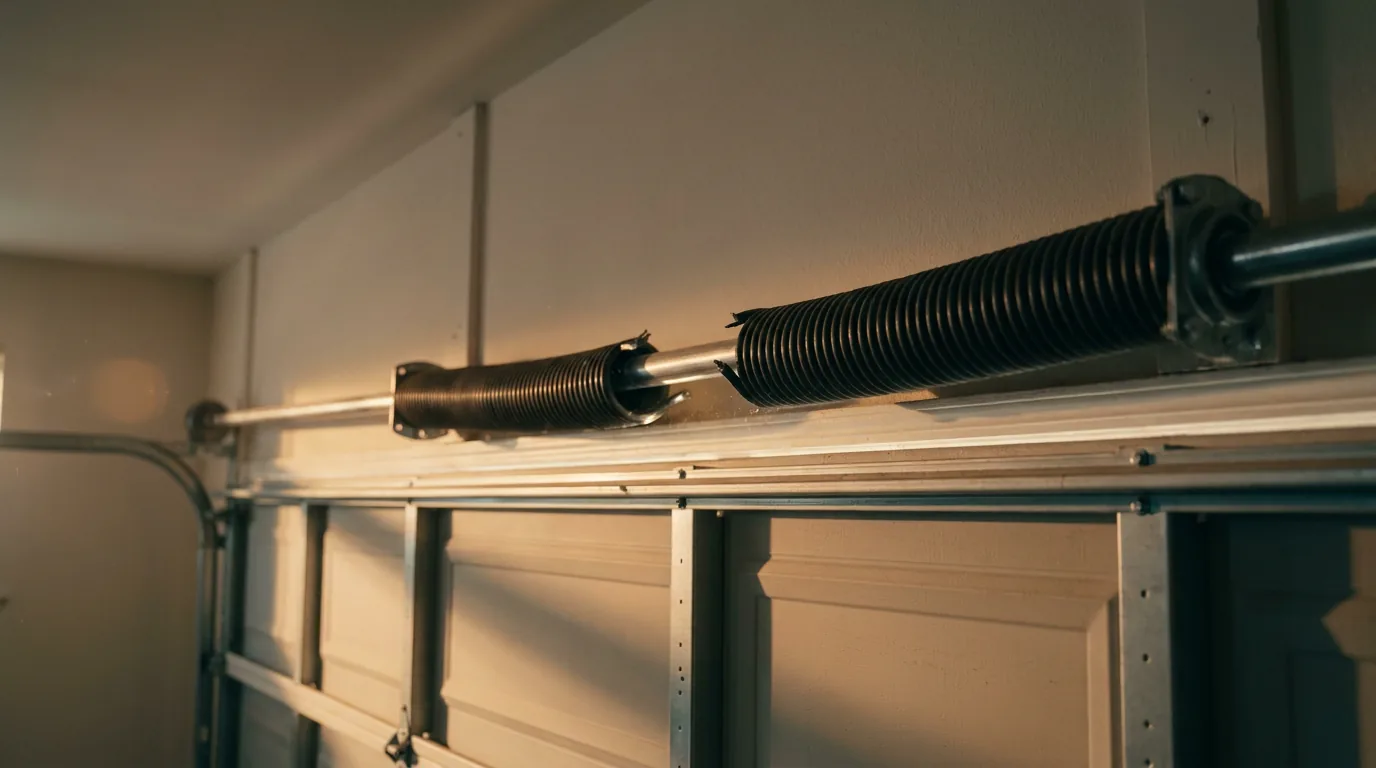
- The spring or springs on the shaft above the door. An intact spring is wound close all the way along. A broken one shows daylight between two of its coils, often a hand-width of it.
- Both cables at the bottom corners. Slack, frayed or hanging loose means the bang may have been a cable letting go.
- Whether the door sits level when it is closed. One corner lower than the other is a cable or a drum.
- The opener rail and the bracket above the door. A rail that has pulled away from the wall, or bowed, will bang every time the door starts.
If you find a gap in a spring, leave the door where it is, unplug the opener, disconnect its backup battery if it has one, and call. Nothing about the next week gets cheaper by running it.
Why a spring can break with the door shut
A torsion spring is wound tightest when the door is closed, because that is when it is holding the most weight. So a spring can break while the door is sitting closed, and the owner often finds out in the morning when the opener strains and the door refuses. The bang at two in the morning and the door that will not open at seven are the same event, told in two instalments.
That is also why a bang with nobody near the door is worth taking seriously. The spring does not need anyone to press anything.
The bangs that are not the spring
If the springs and cables are whole, the noise came from somewhere more forgiving. The common ones:
- A roller dropping across a misaligned track joint, usually where the straight track meets the curve. One clunk, same height, every trip.
- The door hitting its stops at the top because the opener's up limit is set a little too far.
- A loose track bracket letting the whole track shift as the door passes, which sounds much worse than it is.
- A thin steel section flexing, often one that has been dented, popping in and out as it goes round the curve.
Those are adjustments and small parts. They are worth fixing, because a door that bangs every cycle is a door shaking its own hardware loose, but none of them is urgent in the way a spring is.
A sharp crack on a hot afternoon
There is one more, and it tends to arrive with the weather. An uninsulated steel door in direct sun heats quickly and cools quickly, and a thin panel can let go with a single sharp report as it moves. Nothing is broken, and it does not happen while the door is running. If the bang comes on a still afternoon with the door shut and everything above it is intact, the door may simply have been warm.
We would still look at the springs first. The sun gets blamed for a great many things that turn out to be a spring.
What to tell us when you ring
Three details turn a vague noise into a fairly confident guess before anyone leaves the yard:
- Where the door was when it banged: shut, moving up, moving down, or at the top.
- What it has done since. Normal, slower, crooked, or not at all.
- A photograph of the springs from the floor, close enough to see the coils.
With those, we can usually tell you whether it needs someone today or whether it can wait for a morning that suits you.
Three things not to do next
Do not run it a few more times to see whether it does it again. If a spring has gone, each cycle is loading the opener and the cables with the weight of the door. Do not pull the red release cord with the door anywhere but fully down, because on a door with a broken spring the opener may be the only thing holding it up. And do not turn the opener's force up because the door has started to feel heavy. It has started to feel heavy for a reason.
Most bangs are the spring. The rest are cheap.
If you heard a bang, look at the springs before anything else. A gap in the coil is a spring job, the most ordinary repair in this trade and not a reason for a new door or a new opener. No gap, level door, tidy cables: it is almost certainly a track or a limit setting, and it can wait until it suits you.
We would much rather you called about a noise that turned out to be a loose bracket than kept using a door on one spring until the second one joined it. The first call is short. The second is the one that takes the cables with it.
Garage Door Doctor’Z · (833) 991-3899 · doctorzgaragedoor.com
CSLB C61/D28 · Lic. 1138150 · Serving the Sacramento Valley since 2018.