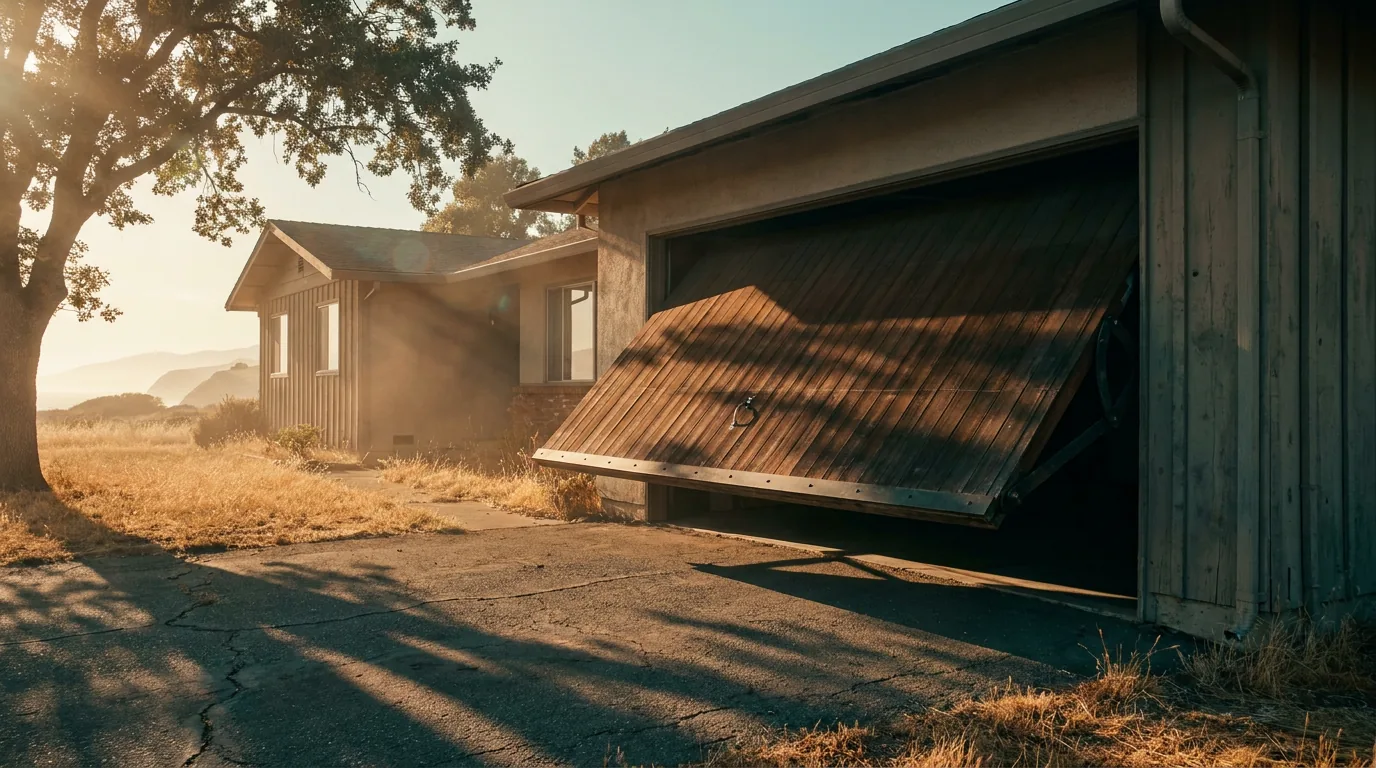
Press the button and the whole door moves at once. The bottom swings out toward the driveway, the top tips back into the garage, and the door rises as a single slab until it hangs flat under the ceiling, its lower edge sticking out past the front of the house. On the side walls, two long springs and a set of steel arms do something complicated that nobody has looked at since the house was bought.
That is a one-piece door, sometimes called a tilt-up or swing-up door. They were common for decades before sectional doors took over, and plenty of older houses still have one. They work on a different principle from the door most advice is written about, and they have their own set of faults.
How a one-piece door actually lifts
A sectional door rolls up in hinged panels along curved tracks. A one-piece door does not bend at all. It pivots. On the common jamb-mounted type, a heavy arm on each side connects the door to a bracket on the frame, and a large spring on each side, stretched while the door is closed, pulls the arms around as it opens. The geometry is arranged so the springs carry most of the weight through the whole swing, which is why a balanced one-piece door can be lifted by hand.
Some one-piece doors run on short horizontal tracks with rollers at the top corners instead. They still swing out at the bottom, but they finish fully inside the garage. Either way, the door is one rigid panel, and every part of the hardware is carrying all of it.
The swing you have to leave room for
Because the bottom of the door swings outward as it opens, anything parked close to the door is in its path. A car pulled right up to the garage, a trash can, a bicycle leaned against it: the door meets them on the way up. On a door with an opener, that is exactly the kind of contact the opener's reversal is supposed to catch, which is one reason the reversal and the photo eyes matter as much on these doors as on any other.
The swing also means the arms pass close to the frame. The point where an arm folds against the jamb is a serious pinch point for fingers, and children should be nowhere near it while the door moves.
What wears out
- The springs. They count cycles like any garage spring, and when one breaks, the door drops on that side and hangs crooked.
- The arms and pivot brackets. They bend if the door has been forced or hit, and the bolts at the pivots wear their holes oval.
- The door itself. Wood doors take on water, gain weight with every coat of paint and can sag in the middle over the years, until the springs are lifting a heavier door than the one they were matched to.
- The frame. The hardware is bolted to the jambs, and a jamb that has softened at the bottom cannot hold a spring anchor.
Can it still be repaired
Often, yes. Hardware sets for one-piece doors are still made, in ratings matched to the door's weight, and replacing springs, arms or both on a sound door is an ordinary job. The door has to be weighed, or its weight worked out properly, because a wood door that has taken on paint and moisture is rarely the weight it was when it went up.
Openers can run one-piece doors too, set up differently from a sectional, and the opener manual covers it. What does not work well is an opener on a door that is out of balance, which is true of every door and slightly more true of this one, because the opener is pushing a rigid panel through an arc.
The hardware works as a matched set. A new spring on one side with a tired arm on the other tends to give a door that rises crooked, which is why the sides are usually done together.
Three checks worth doing once a year
A one-piece door gives less warning than a sectional, because a single panel does not rattle or bind the way hinged sections do. These take a few minutes:
- Look at both springs with the door closed. They should be the same length and evenly stretched, with no gaps or opened hooks.
- Watch the door rise. It should lift level. One corner leading the other means a spring or an arm on that side has weakened.
- Check the pivots for play. An arm that wobbles on its bolt will eventually let the door twist.
None of those involves touching a spring, and none should. On a one-piece door the springs are fully loaded with the door closed, which is how it sits most of the time.
When it is time to change to a sectional door
A one-piece door is not a fault, and nobody should be told it has to go because it is old. There are honest reasons to replace it, though:
- The door itself is rotten, cracked or sagging badly, so new hardware would be lifting a failing panel.
- You need to park close to the door, or the driveway is too short to live with the swing.
- You want insulation and proper seals, which one-piece doors do poorly at the sides.
The catch is the opening. Older garages are sometimes built to sizes that are not standard today, and a sectional door needs room above the opening for its tracks and springs. Both are measured before a quote means anything.
A good quote for the change says how the new door will be framed into the old opening, not just which door it is.
The verdict: an old door is not a broken door
If the door is sound, the springs and arms are parts, and a one-piece door with matched hardware will keep going for years. If the panel itself is failing, or the swing gets in the way of how you use the garage, a sectional door is the better buy. We would rather replace a set of springs on a good old door than sell a new one it did not need, and on a lot of these, that is the honest answer.
Garage Door Doctor’Z · (833) 991-3899 · doctorzgaragedoor.com
CSLB C61/D28 · Lic. 1138150 · Serving the Sacramento Valley since 2024.