

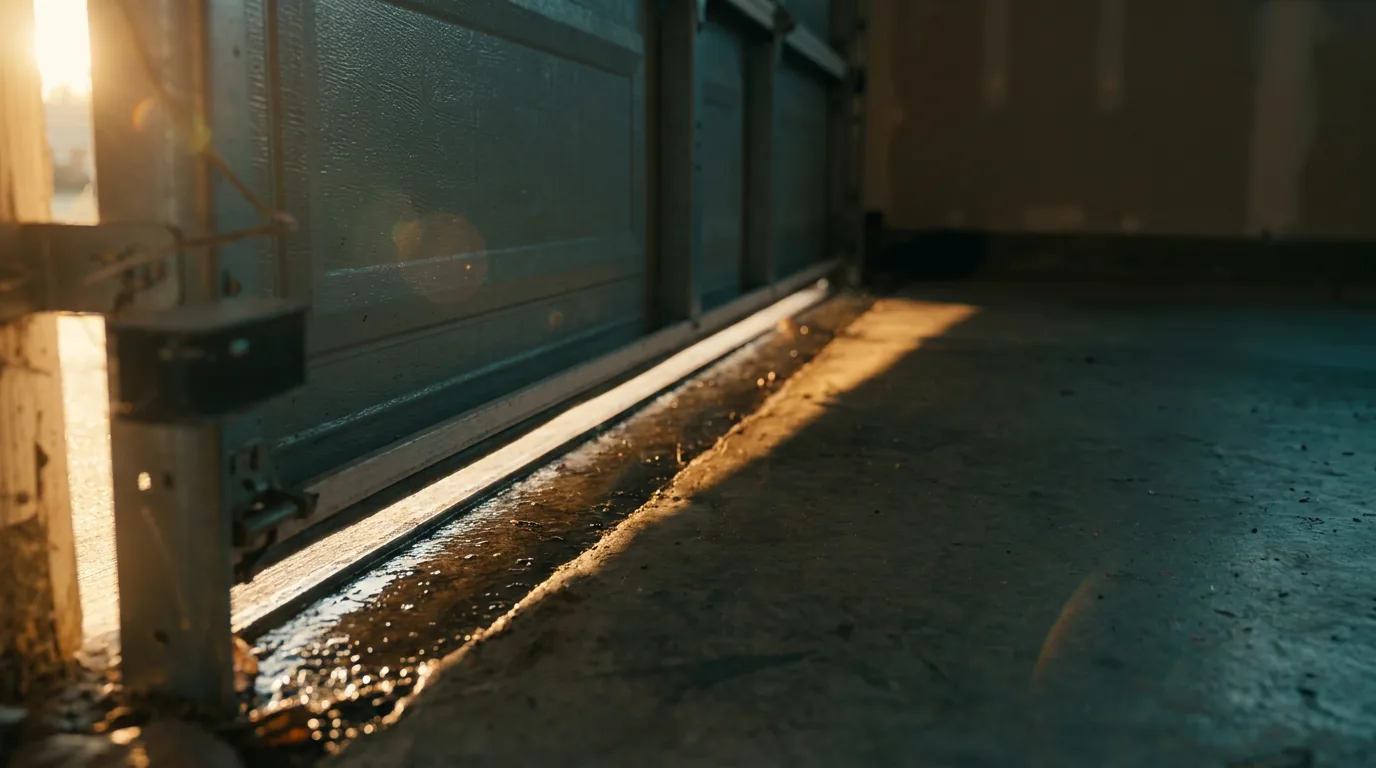
The first proper storm of the season comes through overnight, and in the morning there is a dark tongue of wet concrete reaching in from under the garage door. Along one side, where the door meets the slab at a slight angle, there is a puddle. The boxes stacked against that wall since spring have soft bottoms.
Most of the Valley's rain falls between November and March, which means a bottom seal that hardened and cracked over a long hot summer gets its first real test just as the garage fills up with everything that does not fit in the house. It is worth knowing which part of the problem is the door, because some of it is not.
Three seals, three different jobs
A garage door keeps weather out with three separate pieces, and they fail separately.
The bottom seal is the rubber or vinyl strip along the bottom edge of the door. On most steel doors it slides into a metal channel, called a retainer, that runs the width of the door; on wood doors it is usually nailed or screwed on. It is meant to squash slightly against the concrete and fill the small dips in it.
The perimeter seal, or stop molding, runs up both sides and across the top, fixed to the frame rather than the door, with a soft flap the door presses against when it closes. And some garages have a third, a rubber threshold strip glued to the slab itself, which the door closes onto.
Water at the middle of the door is almost always the bottom seal. Water at a corner can be the bottom seal, the side seal or the slab. Water along the whole width, under a seal that looks fine, is usually the slab.
What a Valley summer does to rubber
A bottom seal on a south- or west-facing door spends June to September pressed against hot concrete, with the steel above it baking in direct sun. Rubber that stays hot for months hardens and loses its spring. It stops filling the dips in the slab and starts bridging over them, and a seal that has taken a set in one shape can crack along the fold.
The sides suffer in a similar way. The flap on a perimeter seal that has been cooked by the afternoon sun goes stiff and curls away from the door, leaving a gap you can see daylight through. That gap lets in rain blown sideways in a storm, cold air on November mornings, and the leaves that collect along that wall every year.
The ten-minute check
On a bright afternoon, close the door, turn off the garage lights and stand inside for a minute while your eyes adjust. Then walk along it:
- Daylight under the bottom edge. A line of light across the middle means the seal is worn or hardened. Light only at one end means the door, or the slab, is not level.
- Daylight up the sides or across the top. That is the perimeter seal, a separate part from the bottom seal and replaced on its own.
- The seal itself. Press it with a thumb. Rubber should give and spring back. If it is hard, cracked or flattened, it is finished.
- The retainer. On a steel door, look at the metal channel along the bottom. If it is rusted through or bent, a new seal has nothing to grip.
- Where the water goes in the next rain. Water that stains the slab inward from the door is getting under it. Water that seeps up from a crack in the floor is not the door's business.
The part of the problem that is not the door
A garage slab is meant to slope slightly toward the door so that water runs out. Over decades the slab can settle, and the driveway apron outside can sink or tilt so that rain on the driveway runs toward the house instead of away from it. When that happens, water arrives at the door with somewhere to go, pools along the bottom edge and finds whatever gap there is. A new seal will slow it down. It will not stop a driveway delivering the whole storm to your door.
If the line of light under the door is wider at one end, check whether the door is level before anything else. A door that sits lower on one side is usually a cable or a drum, and a thicker seal on the high side hides that for a while and fixes nothing.
The fix that makes it worse: lowering the door
The tempting way to close a gap at the bottom is to set the opener to drive the door further down, into the concrete. It works for about a day. After that the opener presses the door into the slab every time it closes, which bows the top section where the opener arm attaches, and it pushes the opener toward the force at which it decides it has hit something and reverses. The door then reopens on its own at night in the rain, which is a worse problem than a damp floor.
If the gap is real, the answer is a seal that reaches the floor, not a door that is driven into it.
What the repair usually is
The common jobs here are small and quick:
- A new bottom seal slid into the existing retainer, matched to the retainer's shape, because there are several shapes and they do not interchange.
- A new retainer when the old one has rusted or bent, which is common on doors that have spent years sitting in standing water.
- New perimeter seals up the sides and across the top.
- The door leveled first, if a cable or drum has let one side drop, so the new seal meets the floor evenly.
- A threshold strip on the slab where the floor itself dips, which can help when the concrete is the gap.
The verdict: seal, level or concrete
If the water comes under the middle of the door and the seal is hard to the touch, the seal is done, and it is one of the smallest repairs a garage door has. If it comes in at one end, check that the door is level before buying anything. If it comes in across the whole width under a soft, intact seal, the problem is the concrete, and the people to call about that are not us.
Garage Door Doctor’Z · (833) 991-3899 · doctorzgaragedoor.com
CSLB C61/D28 · Lic. 1138150 · Serving the Sacramento Valley since 2018.